GNSS-R observation over lake ice; coherency issue

In spaceborne GNSS-R systems like CYGNSS (Cyclone Global Navigation Satellite System), coherence observation is a crucial measurement used to retrieve geophysical parameters of the Earth’s surface. Coherence is a measure of the similarity or correlation between the transmitted GNSS signal and the received signal after it has interacted with the Earth’s surface (e.g., lake ice, ocean, soil, vegetation, etc.).

Here’s how coherence observation works in spaceborne GNSS-R systems like CYGNSS:

  1. Transmitter and Receiver: GNSS-R systems consist of a constellation of satellites equipped with GNSS receivers (receivers) and transmitters (transponders). The GNSS satellites transmit signals towards the Earth’s surface.
  2. Interaction with Earth’s Surface: The GNSS signals, when they encounter the Earth’s surface, undergo various interactions such as reflection, scattering, and absorption.
  3. Reflected Signal Acquisition: The GNSS-R satellites’ receivers capture the signals that are reflected or scattered back from the Earth’s surface.
  4. Coherence Measurement: The coherence is then calculated by comparing the phase and amplitude of the received signal with the transmitted signal. Coherence provides information about the quality of the received signal and how well it correlates with the transmitted signal.
  5. Parameter Retrieval: The coherence information, along with other GNSS-R measurements, is used to retrieve various geophysical parameters of the Earth’s surface. In the context of lake ice monitoring, coherence observations can help in characterizing the state of the ice, such as its thickness and roughness.
  6. Data Processing and Analysis: The coherence data, along with other measurements, are processed and analyzed to generate useful geophysical products and maps that researchers can use for lake ice monitoring and other environmental studies.

By studying the coherence of reflected GNSS signals, researchers can gain valuable insights into various environmental parameters, making GNSS-R an important tool for Earth observation and monitoring.

The reflective surface texture of the Earth’s surface, such as lake ice, can significantly affect the coherency of the reflected signals in spaceborne GNSS-R systems like CYGNSS. The surface texture plays a crucial role in determining the scattering and reflection properties of the GNSS signals, which, in turn, influence the coherence of the received signals. Here’s how the surface texture impacts coherency:

  1. Roughness and Specularity: The surface roughness of the reflective medium, in this case, the lake ice, determines the scattering behavior of the reflected GNSS signals. Rough surfaces can scatter the signals in various directions, leading to reduced coherence, as the phase and amplitude of the received signals become more scattered and less correlated with the transmitted signals. On the other hand, smoother surfaces with less roughness tend to have more coherent reflections, as the signals maintain their original characteristics to a higher degree.
  2. Depolarization: The surface texture can cause depolarization of the reflected signals. Depolarization occurs when the orientation of the electric field of the reflected signal becomes randomized due to surface roughness or scattering mechanisms. This depolarization can lead to a reduction in coherence since the original polarization characteristics of the transmitted signal are no longer maintained in the received signal.
  3. Multiple Scattering and Interference: In some cases, the reflected GNSS signals may experience multiple scattering events due to complex surface structures. These multiple scattering events can lead to interference patterns, causing reduced coherence in the received signals.
  4. Melting and Refreezing of Ice: In the context of lake ice monitoring, the surface texture of the ice can change due to melting and refreezing processes. When ice melts and refreezes, its surface can become rougher, leading to changes in the coherence of the reflected GNSS signals over time.
  5. Snow Cover and Surface Liquid Water: In the case of lake ice, the presence of snow cover or surface liquid water can also affect the surface texture and, consequently, the coherency of the reflected signals. Both snow and water can introduce additional scattering mechanisms that influence coherence.

During the transitioning times when the lake state changes from open water to lake ice and vice versa, the coherence of reflected GNSS signals in a spaceborne GNSS-R system like CYGNSS can be expected to undergo significant changes. These changes are primarily influenced by the differences in the surface properties and scattering mechanisms between open water and ice. It’s important to emphasize that the coherence of reflected GNSS signals is influenced by multiple factors, including surface roughness, dielectric properties, surface liquid water, and snow cover, as mentioned in my previous response. Wind-driven roughness during open-water conditions is one additional factor that can affect the coherence and should be considered when studying the lake’s behavior during the transitioning times from open water to lake ice.
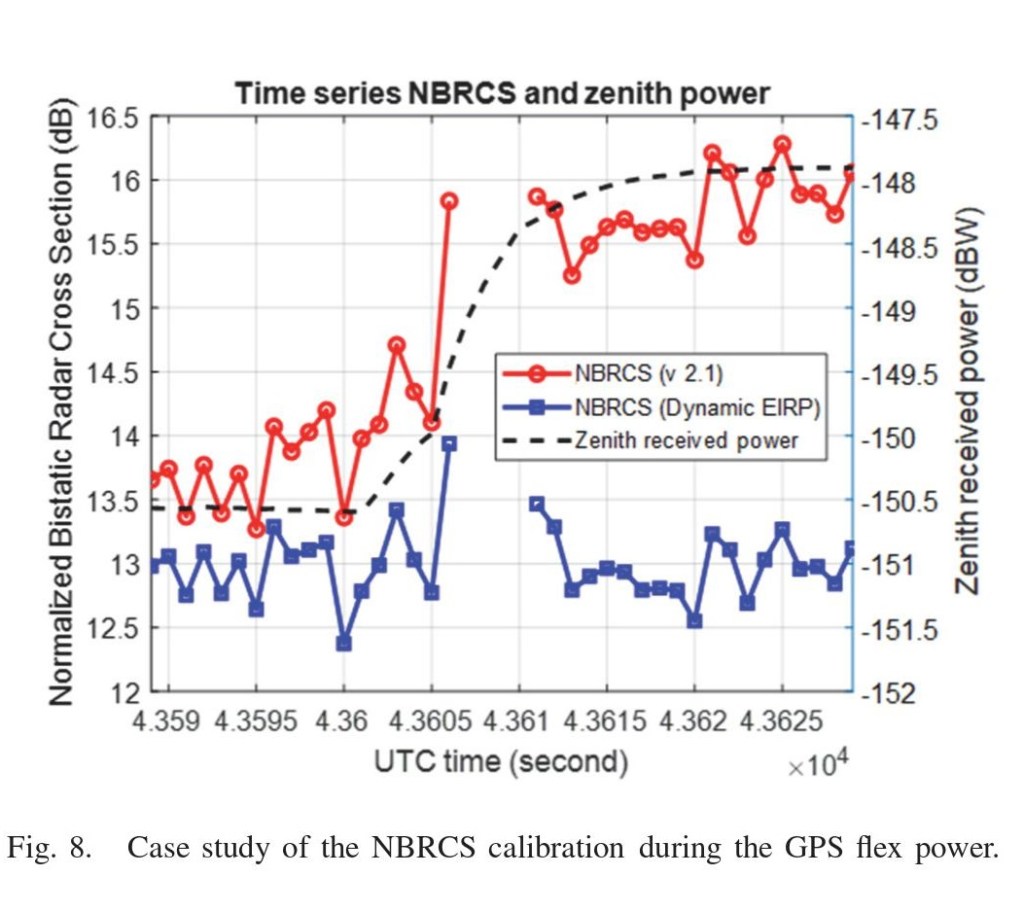
Importance of Effective Isotropic Radiative Power (EIRP) for GNSS-R Lake Ice Remote Sensing

GNSS-R applications for lake ice remote sensing is still under study, and there are many vague points in this subject, especially for those like me who are “encore vert” in this topic. Among various corrections and calibrations must be made on GNSS-R data, EIRP looks decisive; however, a genius solution has been recently proposed for that: dynamic calibration.

Postdoctoral researcher with the University of Michigan Tianlin Wang, who is known with his insightful research items on microwave instrumentation of GNSS-R systems, has recently published a paper expanding the concept and application of the dynamic calibration of EIRP for GNSS-R remote sensing. This research item, which has been conducted in co-authorship with a number of GNSS-R giants, such as Dr. Chris Ruf and Dr. Scott Gleason, is in the following of a conference paper that had been presented at IGARSS 2019. In this research, authors have discussed the necessity of various calibrations should be applied to normalized bistatic radar cross section (NBRCS) measurements as it is a key to obtain physical insights into the mechanism of GNSS-R scattering from reflective surfaces. Among those calibrations, the one applied to EIRP has been discussed as one of the most challenging as it has to overcome multiple major challenges including variations in the transmit power, inaccuracies in antenna gain measurements, and the flex transmit power. Being mentioned as the most important motivation of this research, the latter challenge, i.e., flex transmit power, will cause changes in CYGNSS level-1 NBRCS values, which may limit the mission’s potential by flagging out up to 37% of observations. In this dynamic calibration method, direct GPS signals are used to estimate the EIRP in the direction of specular reflection point, and by implication, calibrate the NRBCS.

It is my understanding that this correction is crucial specially for CYGNSS as it is classified among conventional GNSS-R approaches (vs. interferometric GNSS-R), in which the narrower bandwidth of the public codes (for more information on iGNSS-R and cGNSS-R, and their application in ice altimetry, see this paper). Moreover, the calibration quality of NBRCS could be extremely decisive as the roughness of the reflective surface increases. Roughness can be really challenging in lake ice GNSS-R remote sensing as I have mentioned here and here. Moreover, under this LinkedIn post, which was about the same topic, two GNSS-R researchers (Ben and Lucy) discussed various sources of uncertainty in CYGNSS remote sensing specifically for lake ice studies. Tianlin’s paper seems to open a new way to improve CYGNSS ability in lake ice remote sensing.

CYGNSS and Spatial Interpolation; a Review

“Why talk to others when you can talk to yourself?” This is how Clara Chew captioned her fantastic YouTube video in LinkedIn to start suggesting a spatial interpolation method for CYGNSS data.

First of all, I should say what a great idea form one of my most inspiring and favorite researchers. Establishing a YouTube channel to talk to ourselves about GNSS reflectometry is what we’d need, and to be honest, that’s the main encouragement for myself to kick off this website. Although I am currently the only writer here, but this platform is going to become an online magazine for GNSS-R researchers to freely read and write others’ opinions. It’s yet to be widely advertised, but the core idea is the same: let’s just talk to ourselves : )

About the video, let’s start from the end; this method is not going to be used for every application. “If you are trying to do some sort of analysis where you need exact knowledge of reflectivity at a certain point,” Clara clarifies “you might not want to use this method”. It sounds very true for my current research focusing on Qinghai Lake, Tibet Plateau, where I restricted Fresnel Zones to only the central region of the lake to make sure that I am not receiving reflections from the surrounding lands or even the shore lines. So, no interpolation is required at any level. But aside from the Qinghai’s research, it’s been a few months that I’ve been thinking about expanding my CYGNSS explorations to a wider region, say central desert of Iran, and meanwhile, one of my greatest concerns has been how to do data interpolation over a large area. Clara has also mentioned it somewhere in her video that “trust me, it won’t be too frustrating”, but it is for me :)) because I haven’t started yet.

But when I’m saying my concern is on how to do it, I wouldn’t say that choosing the interpolation method is not a big concern, as it really is, but it is not the biggest issue for me, because I had practiced a method years ago. The story took place in 2013-2015, when I was working on geodynamics of the Earth, and my specific research at that time was calculating strain tensors. I found out that routine methods for interpolating crustal movement values, e.g. IDW and Spline, are way off the road. I spent couple of months on that, and realized that “deterministic interpolation methods” do not perfectly work for those problems which require “geo-statistical interpolation methods”, such as Kriging. That was the point.

In short, despite deterministic methods which only consider distance as the effective parameter in weighting procedure, geo-statistical interpolation methods also take the correlation into account as a weighting function. This is exactly what Clara suggested: “correlation coefficients“. In Kriging, for example, a covariance matrix is created among node points based on statistical constraints, and then, that matrix plays a key role in establishing the weighting function. The same idea can be seen in another powerful interpolation method called Least-Square Collocation, which is widely used in geoid problems and potential field anomaly interpolations.

I employed Ordinary and Universal Kriging interpolation techniques for estimating strain matrix components, and improved the accuracy up to 70%. As Clara has remained the discussion open at the end of her video, I would invite her to a collaboration in order to explore the ability of geo-statistical methods of interpolation in CYGNSS cases.